FOXO4-DRI (10mg) - senolytic, anti-aging agent, geroprotector
10 mg, lyophilizate
Please verify the availability of the product in stock before proceeding with the order.
FOXO4-DRI (Forkhead box protein O4) is a protein that in humans is encoded by the FOXO4 peptide gene. It is located on the long arm of the X chromosome at positions 71096148 to 71103533. Three more members of the FOXO family are known - FOXO1, FOXO3 and FOXO6. The action of these proteins is regulated by post-translational processes, acetylation, ubiquitination, and phosphorylation, which influence various cellular pathways such as oxidative stress response, longevity, insulin response, cell cycle progression, and apoptosis. The two major regulators of the FOXO4 protein are phosphoinositide 3-kinase (PI3K) and serine/threonine kinase AKT/PKB. FOXO transcription factors are downstream effector molecules of the insulin-like growth factor signaling pathway. The FOXO cascade may initiate longevity-related genetic pathways, as has been shown in Caenorhabditis elegans. Such activation leads to the prolongation of the life of worms, insects and mice.
Aging is the progressive loss of function of tissues and organs over time. The antagonistic theory of pleiotropy (the influence of a single gene on several phenotypic traits) suggests that an organism's fitness is reduced, at least in part, because natural selection favors genetic programs that have a positive effect on reproductive fitness at an early age, without taking into account the negative impact on health after reproductive age. One set of genes that arguably qualify as antagonistically pleiotropic are the regulators of cellular aging, a powerful antitumor mechanism that prevents malignancy by permanently removing (pre)tumor cells from the cell cycle, but is also the driving force behind aging and age-related diseases. Aging has two aspects. First, it causes loss of tissue repair capacity due to cell cycle arrest in progenitor cells. Secondly, senescent cells produce pro-inflammatory and matrix-destroying factors in the so-called. senile secretory phenotype (SASP, Senescence-Associated Secretory Phenotype). One reason that cellular senescence may have evolved as an anti-cancer mechanism, along with programmed cell death, is that senescent cells can be "cleaned out" by immune cells that are recruited by pro-inflammatory factors secreted as part of SASP. Recently, evidence points to positive effects of cellular senescence, for example, in wound regeneration and in embryogenesis. Under these conditions, aging plays a remodeling role in relation to tissue, and senescent cells have a relatively short half-life because they are efficiently cleared by immune cells. In contrast, older cells that chronically accumulate damage eventually reach a cellular stress threshold that causes them to exit the cell cycle.
Eliminating senescent cells and attenuating SASP appear to be attractive therapeutic strategies; however, at present, the transfer of these results to applications in human therapy is limited by a fragmentary understanding of both the basic molecular biology of senescent cells in vivo and aging as a cause of age-related diseases in general.
Hayflick's discovery of replicative aging has led to suggestions that cellular and general aging may be causally related. Primary human cells undergo a limited number of divisions in vitro (the Hayflick limit), which gave rise to the cell-autonomous theory of aging, according to which aging depletes tissues of replication-competent cells necessary for homeostasis, repair and regeneration. Stopping division in culture has since become a model system for studying the molecular causes and factors of aging, and finding means to combat it.
Anti-aging and geroprotective drugs must meet the following criteria: the possibility of increasing life expectancy; decrease in the rate of progression of age-related disorders; have maximum benefit and acceptable toxicity; improve the quality of life of the elderly; increase the body's resistance to adverse environmental factors. According to the modern classification of geroprotectors, they are divided into: mitochondria-oriented antioxidants; glycation product modifiers (AGEs); inhibitors of lipid peroxidation products (ALE); calorie restriction mimetics; epigenetic modulators; immunomodulators; hormones and hormone-like substances.
Senolytics (from senile - decrepit and lytic - lysing, destroying) can be attributed to epigenetic modulators. This is a class of anti-aging drugs, a distinctive feature of which is the ability to selectively initiate apoptosis (programmed death) of aged cells. Drugs are typically small molecules that are under investigation to evaluate their ability to selectively kill senescent cells and improve human health. The goal is usually to discover or develop means to delay, prevent, alleviate, or reverse age-related diseases. A related concept is "senostatic", which means the suppression of aging.
FOXO4 D-Retro-Inverso is identical to the protein product of the FOXO4 gene, but the normal L amino acids have been exchanged for D amino acids. The result is that FOXO4-DRI has reduced susceptibility to normal physiologic clearance mechanisms and thus remains in the body for longer periods of time. The modified protein is still capable, however, of affecting transcription and cellular pathways. In general, the FOXO4-DRI protein interferes with normal FOXO4 function.
Of greatest interest in terms of aging and senescence is the ability of FOXO4-DRI to interfere with normal FOXO4 signaling in the cell cycle by preventing the binding of FOXO4 to p53. The p53 protein is an important regulator of progression through the cell cycle as well as programmed cell death (apoptosis). When FOXO4-DRI binds to p53, it prevents FOXO4 from binding and allows p53 to bind to DNA. This, in turn, allows the cell to continue through the process of apoptosis and die.
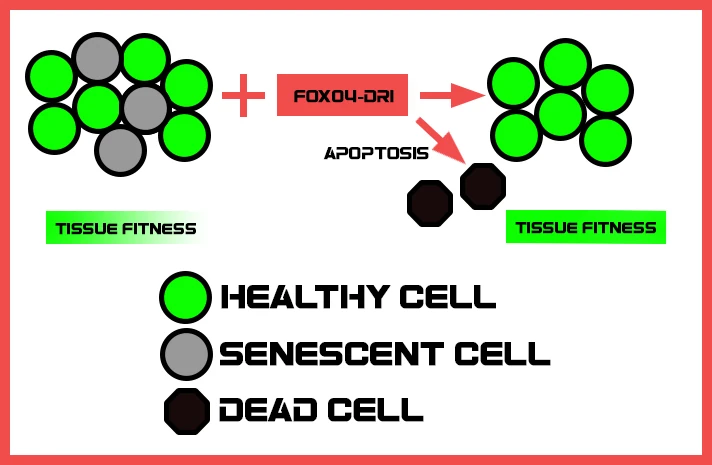
Interestingly, FOXO4-DRI appears to have this effect in senescent cells, cells that are no longer functional or are dysfunctional as a result of aging. By targeting these dysfunctional cells, FOXO4-DRI helps to rid tissue of cells that are nothing but dead weight. This, in turn, allows for better tissue functioning and helps to stimulate growth and differentiation of younger, healthier cells. The net result is better biological function and thus a decrease in “biological age”.
FOXO4 lives in the nucleus of the cell and p53 does its work at the mitochondrial level — two very different sites in the inside of a cell. A way had to be found to separate P53 and FOXO4 from each other so that p53 could do its job and destroy the senescent cell from the inside. To do this another version of FOXO4 was created that had a Trojan horse effect ( it acted like FOXO4 from a chemical standpoint) . This molecule looked like FOXO4 to the cell, and it acted like it too, but this peptide called FOXO4-dri, didn’t only live in the nucleus — it could exist at any place inside the cell.
The p53 breaks away from FOXO4 when FOXO4-dri is introduced into the senescent cells. Because of this effect the cell can do it’s work and the cell can undergo apoptosis — it can finally commit suicide. Therefore, it does not hang around and signal harmful chemical messages to the other cells. This is what occurs in younger subjects, where this mechanism is at peak. Therefore, a senolytic virtually recreates a younger cellular environment. Once senescent cells are killed off, past a threshold level of them being toxic, healthy cells are allowed to flourish.
Quantity: 10 mg
Purity: over 97%
Form: lyophilizate
Excipient: mannitol
Storage: no more than +5C
Amino acid sequence: D-isoform Leu-Thr-Leu-Arg-Lys-Glu-Pro-Ala-Ser-Glu-Ile-Ala-Gln-Ser-Ile-Leu-Glu-Ala-Tyr-Ser-Gln-Asn-Gly-Trp-Ala-Asn-Arg-Arg-Ser-Gly-Gly-Lys-Arg-Pro-Pro-Pro-Arg-Arg-Arg-Gln-Arg-Arg-Lys-Lys-Arg-Gly
Molecular weight: 5358.2
Molecular formula: C228H388N86O64
Synonyms: D-Retro Inverso Forkhead box protein O4, FOXO4-D-retro-inverso, FOXO4, ФОКСО4, LTLRKEPASEIAQSILEAYSQNGWANRRSGGKRPPPRRRQRRKKRG, H-ltlrkepaseiaqsileaysqngwanrrsggkrppprrrqrrkkrg-OH
Main area of research: senolytic, anti-aging agent, geroprotecto
By purchasing Russian Peptide product samples from this site, you understand that they are for research purposes only and not for the treatment of humans or animals.
Method of application:
The products are for professional use only. Peptide products are intended for research and scientific purposes only.

Guaranteed authenticity and quality:
100% original product from RUSSIAN PEPTIDE (Russian Federation)
RUSSIAN PEPTIDE is a commercial, innovative technology-based organization providing a full range of services to the pharmaceutical, biotechnology and cosmetics industries.
The company specializes in the development of technology and production of peptides and complex organic molecules as biologically active ingredients and their intermediates, biochemical substances for in vitro research purposes, reference standards for the calibration of analytical equipment, as well as reagents for peptide synthesis.
Development and production:
RUSSIAN PEPTIDE is a commercial, innovative technology-based organization providing a full range of services to the pharmaceutical, biotechnology and cosmetics industries.